Thursday, March 25, 2010

THREE DAY BICYCLE TRIP (Pt. 1)


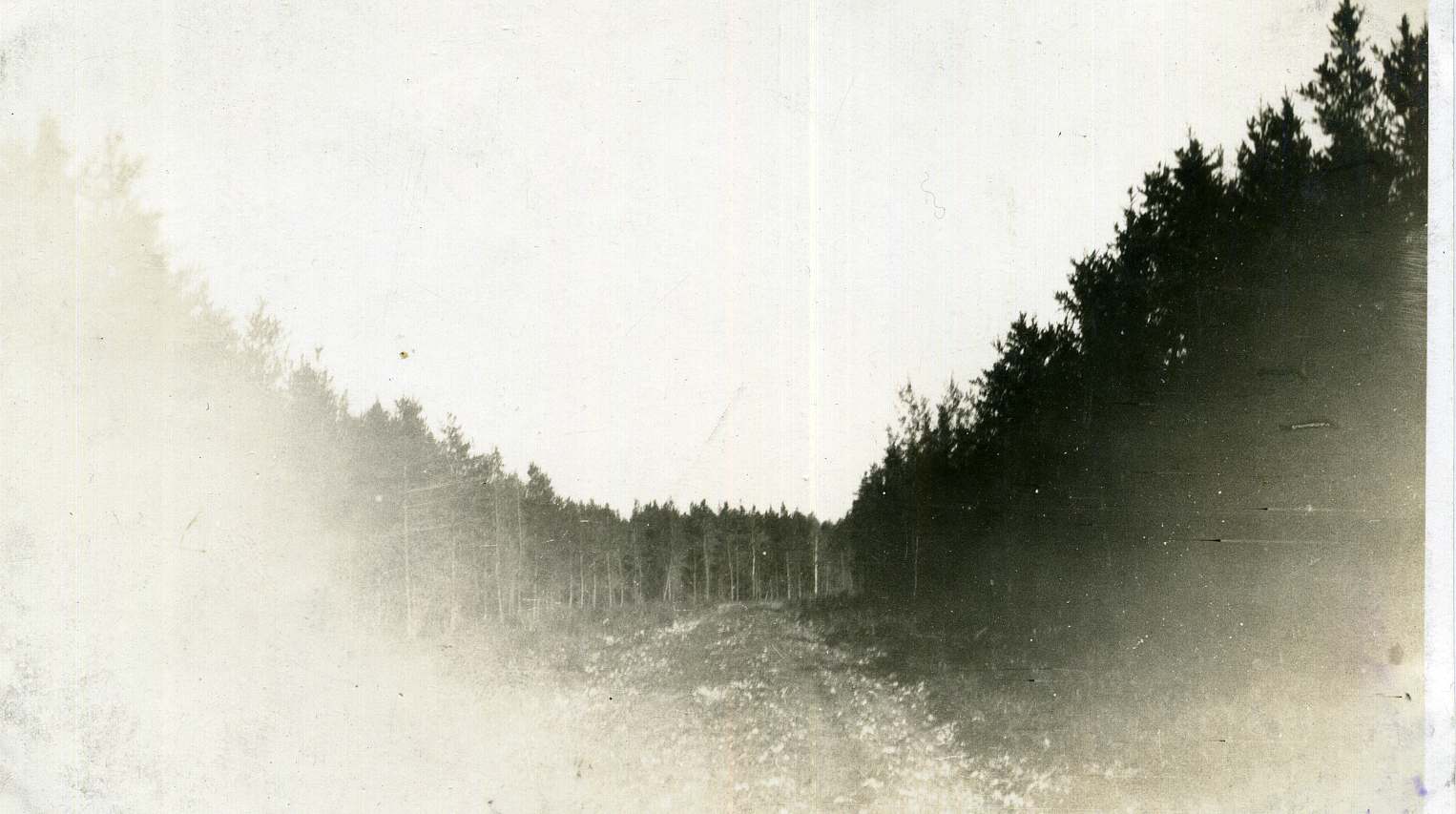
Back of the photo says, "Renvier, Manitoba, September 2, 1922. Swamp in road 3 miles east of Renvier on road to Cowan." Album says, "The trail almost disappears near Renvier, Manitoba."


Back of the photo says, "Jack pine on road near Cowan." Album caption says, "Some roadwork has been done near Cowan."


Back of the photo says: "Cowan, Manitoba. Galacian Church east of Cowan. September 3, 1922." Album caption says "Ruthenian Church near Cowan."


Back of the photo says, "Haystack hotel at Cowan. September 3, 1922." Album caption says, "I slept overnight in this haystack near Cowan." I find no evidence that anyone else was with him. I come by my genes honestly, but I think that I was in more danger on the road in my van than he was on his bicycle. I'd prefer bears to delinquents any day.

Tuesday, March 23, 2010

WHERE RIVERS MEET

In the days when travel was by water, if not floating on it then riding or walking alongside it, knowing one's confluences was as important as today's Rand McNally road map.


August, 1922. The album says: "Roaring River (left) runs iinto the Swan River (right) looking upstream." Back of the photo agrees.


Caption: "The Favelle River (center-left) runs into the Roaring River here.


This one says, "An island forms in the Swan River just below the mouth of the Roaring River." Dated August on the back of the photo.


" July 1, 1922. Looking down a placid stretch of the Swan River from the Doverspike Bridge." "South from Minitonas," adds the back of the photo. Both beaver and man have been at work here.

Monday, March 22, 2010

WORK AND PLAY IN LATE SUMMER

Working hard at harvest means hot weather and sweat equity. In the Twenties there were no air-conditioned cabs -- not even many tractors and the ones that were ran on steam.


I don't know whether this hay is grass or alfalfa. I suspect the former, as I seem to see long stems rather than the more herb-like alfalfa which may not have been imported yet. The method, called a "beaver slide stacker" in Montana, is still used in some places. It is horse-powered. Is that Inez? The rack on which the hay is piled and rising will go vertical, throwing the hay over onto the pile or "stack." This is on the Strachan farm in September, which would also suggest grass, maybe from that flooded meadow.


This is August on the J.F. Smith Farm, section 11. The method is old-fashioned European stacking by hand, though this was probably cut with a swather. The Strachans might have been leasing this land to raise the crop or maybe the photo was taken out of admiration. Certainly that's a fine barn in the background. The shed might be left from homestead days or just be shelter for animals.


The local idea of how to celebrate a Sunday -- this one in July, 1922, was to go to a high cool place -- Favelle Gorge in the Duck Mountains -- and have a picnic. I believe this pattern went back to the local indigenous tribes and may even go back into our primate ancestors, though they usually got to the pleasant place and just ate what was there. No frying up chicken in advance. This pattern persists among the Strachans to this day. All through my childhood we trekked up a much grander gorge, the Columbia Gorge between Washington and Oregon states, towing relatives from flat country along to be amazed.


July, 1922, and maybe the ghost of the Fourth of July as celebrated in South Dakota is in attendance. The Strachans and the Hendersons are clearly bonded by many picnics together. I can't name the Hendersons. Beulah Strachan, my grandmother, is on the left with her lace collar and what my grandfather called "her tooerie," the bun on the back of her head. He might be the one leaning against the tree where my father's camera case hangs. Plainly someone with the initials BK has been there earlier. May is just to the left of the tree and then possibly Glenn to her left. I think Seth is sitting just in front of Papa. The rest will be Hendersons.

Sunday, March 21, 2010

FIRST WEST FAVELLE PLOWING MATCH

Bruce Strachan is competing in this June event! At least he doesn't have to walk behind the plow. He sits up high on his machine with his camera case slung over his shoulder.

I'd be interested to know whether West Favelle has plowing matches these days -- maybe with tractors. In Oregon horse-team plowing and logging have come back to life and I've watched those big old horses turn the ground over. Actually, those were feather-footed heavy horses, but these look a little lighter: utility horses, so to speak. So they can pull the wagon and buggy as well.


The names of these horses, left to right, are Inez, Polly and Judy. Inez is a little unusual for a horse name. None of them looks very Spanish. Maybe Polly and Judy are the matched pair and Inez is the dark buggy horse, a little fancier. Actually, they all seem more "dressed" than one is used to seeing. There must be briars or sapling whips in the grass for them to be wearing pants on their front legs. The dark horse also has a hanky on her nose to repell biting flies and the middle horse appear to be wearing a hat! One generally plows with mares or geldings. People in this time and place kept no stallions but a man with a good stud would tour the country doing the honors. Richard Kroetch's marvelous novel, "The Studhorse Man," tells the story.


My father was a steady and calm man in the early part of his life. There appears to be just a glimpse of what Charlie Russell called a "skunkwagon" barely in the photo on the left. Of course, being a cowboy, his opinion of plowing was not very high. He called it "turning the prairie upside down." The horse in the middle appears to have found herself a switch to chew up.


These furrows earned Bruce Strachan second prize. I expect the whole family took pride in that, since that's generally how they reacted, like a sort of mini-clan.

SPRING HIGH WATER 1922

The story of water in the West almost anyplace is that there's always either too much or too little. As the rancher said over Sunday dinner, "Chicken today -- feathers tomorrow." In spring when the weather warms up enough to melt all the ice and snow, there is plenty of water.


April on the Roaring River means sheets of over-the-bank sediment-laden water. On the good side, the mud is a soil enhancer.


But here's a problem: the high water has undercut the bank and it has slumped into the water.


At last it seems the river is really "roaring" and this looks like a proper waterfall until you spot my father standing next to the cataract. This is in May and the water is overflow draining the land and REMOVING all that sediment. Ack!

Friday, March 19, 2010

TO LA PAS TO SELL POTATOES

La Pas ("the Pass" in French) was named by the voyageurs. I'm unclear about what it's the pass to or from. This far north the land is mixed with water bodies (when they are liquid) so much that a strong man and a canoe with a compass could go just about anywhere and find plenty of beaver on the way. The Saskatoon folks, when I was there, considered it to be frontier yet. "Pretty rough country," they said. The Indian population is high, which probably skewed their opinions.


The back of the photo says "Government Bridge across the Saskatchewan River at La Pas." This is the railway to Hudson Bay, a town north of Swan River about halfway to LaPas, so this must have been the way Sam and the potatoes arrived. La Pas is the "Gateway to the Arctic North." I'm unclear about the final destination of these spuds.


The photo back says "Steamboat on the Saskatchewan River," which goes through Saskatoon and finally empties into the water body called "Hudson's Bay." It's a slow shallow river in most places, or so I remember it. Nothing like the Missouri/Mississippi complex that drains inland USA.


The romance of the boxcar, almost a little house on wheels, and who knows what might be in there or where it might go if you hitched a ride. These are sitting on the siding for a sawmill, which explains why there is a waste burner alongside. It's a tall tower with screen on top to prevent sparks from setting the prairie on fire, not like our tipi-shaped burners meant to be braced against the wind. The chimney might be for the actual sawing steam engine. In the background there appears to be a grain elevator.


No doubt this is where "Papa" stayed, but there are no details. In fact, I'm not even sure he took anyone along with him.


The Rand McNally road map says La Pas has "Old Christ Church" but I don't know whether this is it. There's little to Google in La Pas. Maybe there's someplace on the planet that the Chamber of Commerce doesn't have a website after all. The album notes "New church," which explains the scaffolding. It looks to me as though the building to the left is a school, probably a boarding school for Indian kids. In fact, it appears to me that this is a whole center of some sort. Curious how religion and education get conflated. It's perfectly possible that this is where the potatoes went to be peeled and eaten by students.


This is the house of the doctor in La Pas, clearly bigger than most, but not what one would call a mansion today. A solid house, very well fenced, with a clothes drying lazy susan in the backyard. The windbreak/shade making evergreens are also a sign of prosperity. Note it is the only photo with trees in it.

Tuesday, March 16, 2010

COMES 1922

The round of chores when you live on the land gets into synch with the round of the seasons until things fairly hurtle along.


A good farmer is always looking for ways to use up the surplus and maximize the profit. Feeding yearling steers the cull potatoes to fatten them up for slaughter is a good move and the cows, not being able to see into the future, like the idea as well. These look like beef cows, but I can't tell what breed. Seeing how much they like potatoes, maybe they're Irish.


Looks like big plans for building this year. A big stack of Strachan's lumber at Martin's Mill, right next to the road so it will be easy to load up. But I'd wait for things to dry out a little more before driving in to collect something heavy. Anyway, it's not a good idea to build with green lumber. No hurry.


The customary April ice jam on the Roaring River. It will be a while before anyone dares to wade.